恐怖游轮
Third China-US Track 1.5 Dialogue held in Beijing as attendees discuss constructive strategic stability, practical cooperation_我的网站

一 | 曾红极一时的烘焙咖啡品牌“85度C”近日正频繁闭店。
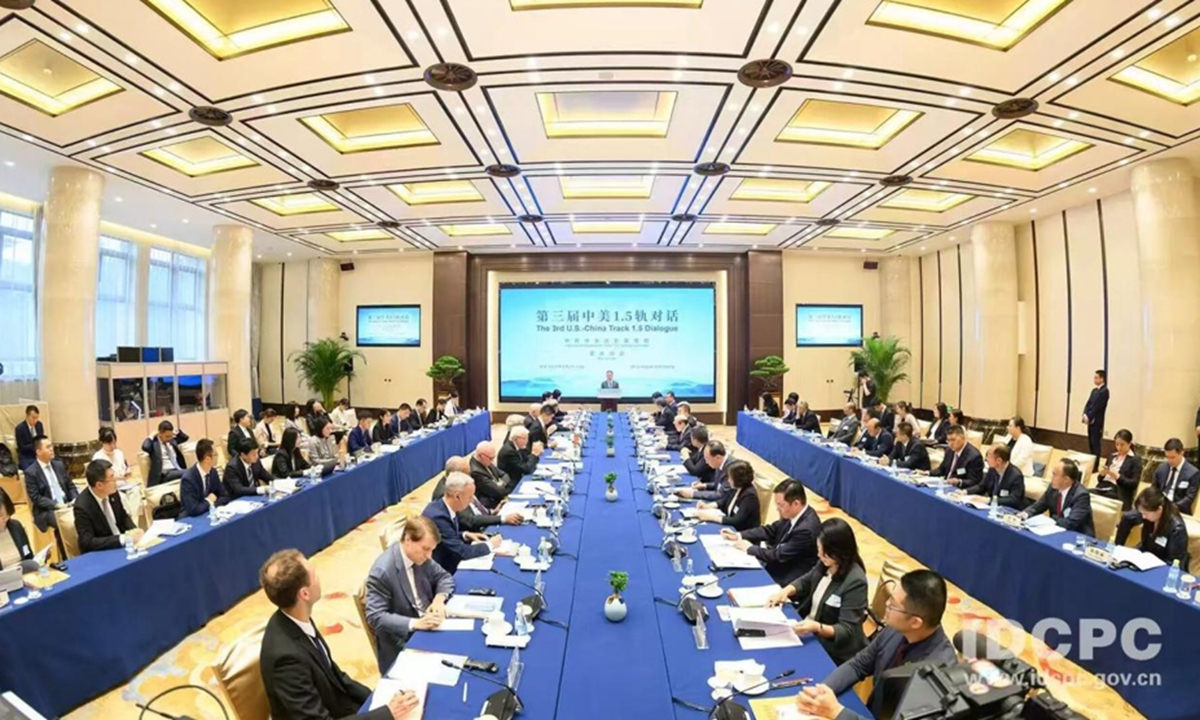
The International Department of the Central Committee of the Communist Party of China (IDCPC) and the American Asia Society holds the third China-US Track 1.5 Dialogue in Beijing, China on August 25, 2026. Photo: IDCPC's WeChat account
The third China-US Track 1.5 Dialogue was held in Beijing on Tuesday, bringing together government officials, scholars and business representatives from both countries for discussions on constructive strategic stability and practical cooperation.
Co-hosted by the International Department of the Central Committee of the Communist Party of China (IDCPC) and the Asia Society, the dialogue was attended by about 40 representatives. Participants included officials from relevant Chinese government departments and local governments, experts from think tanks and universities, as well as figures from US strategic and business circles, including John L. Thornton, co-chair of the Asia Society Board of Trustees.
Under the theme "Constructive Strategic Stability - Practical China-US Cooperation in the New Era," the participants held candid, in-depth and constructive exchanges, according to the IDCPC's release on its WeChat account on Tuesday.
Addressing the dialogue, Liu Haixing, head of the International Department of the CPC Central Committee, said the two sides have recently followed the direction set by the two heads of state, taken practical steps to strengthen communication and dialogue, advanced a positive agenda and achieved notable results.
Liu called on the two countries to continuously enlarge common interests and make cooperation the anchor of positive stability. He urged the two countries to uphold mutual benefit and reject zero-sum games so that competition remains within bounds, to seek common ground while managing differences, and observe the bottom line of no conflict and no confrontation to achieve lasting peace and stability.
Participants discussed ways to enhance political mutual trust, expand economic and trade cooperation, and explore cooperation in artificial intelligence, science and technology, CCTV News reported.
Established in 2023, the China-US Track 1.5 Dialogue operates between formal government-to-government diplomacy, known as Track 1, and purely nongovernmental exchanges, known as Track 2. The second dialogue was held on June 13, 2024, during which participants held candid, in-depth and constructive exchanges around the theme of "sharing perspectives and finding solutions on key and urgent issues."
As a channel involving both government and nongovernmental participants, the Track 1.5 mechanism can help China and the US communicate more effectively, identify common ground and better understand the consensus reached by the two heads of state, Zhou Mi, a senior research fellow at the Chinese Academy of International Trade and Economic Cooperation, told the Global Times on Tuesday.
It can also help translate the consensus into greater mutual understanding and concrete action, Zhou said.
Discussions on AI at this year's dialogue could help the two sides identify shared interests despite existing frictions and technological challenges, creating opportunities for practical cooperation and laying the groundwork for follow-up efforts, he noted.
Wang Yiwei, a professor at the Renmin University of China's School of International Studies, told the Global Times on Tuesday that the Track 1.5 dialogue serves as a bridge between Track 1 and Track 2, allowing participants to discuss sensitive issues and explore policy space while conveying frontline assessments and feasible proposals to decision-making departments.
Liu outlined practical pathways for China-US cooperation in the new era. First, the two sides should uphold mutual respect, peaceful coexistence and win-win cooperation, steer China-US relations to overcome the "Thucydides Trap," and create a new paradigm of major-country relations.
Second, the two countries should jointly shoulder their responsibilities as major powers, make constructive interaction an important driver of international cooperation, address global challenges together and inject greater stability into the world, Liu noted.
Third, they should expand exchanges and cooperation in trade, public health, agriculture, tourism, people-to-people ties, law enforcement and cooperation between localities, thereby strengthening the resilience of bilateral relations and working toward a better future, Liu said.
Overcoming the "Thucydides Trap" fundamentally rejects the notion that conflict between major powers is inevitable, Wang Yiwei said. It reflects an effort by China and the US to pursue a path different from the historical confrontation between an established power and a rising one.
Such a model does not seek to avoid competition altogether, but to ensure that competition has boundaries, differences remain manageable and cooperation retains sufficient space, Wang Yiwei said.
To put this approach into practice, the two countries should respect each other, avoid crossing red lines concerning core interests and reduce the risk of strategic miscalculation. They should expand areas where their interests converge and establish regular cooperation mechanisms on global issues such as climate change, public health, food security and AI safety, turning shared responsibilities into joint action, he noted.
As the world's two largest economies, China and the US should recognize that many global challenges cannot be effectively addressed without coordination between them, particularly at a time of intensifying competition. Constructive engagement is therefore not a temporary expedient but a long-term responsibility that major countries should undertake for the world, Wang Yiwei said.
The dialogue came a day after China's top political advisor Wang Huning met with US delegates attending the event in Beijing on Monday.
During their meetings, the US side said that the US-China relationship is at a special juncture, adding that the sound rapport between the two heads of state constitutes the most valuable and important part of bilateral ties. The US side agrees that both sides should act on the consensus of building a constructive US-China relationship of strategic stability, advance corporate cooperation, expand people-to-people and cultural exchanges, guard against risks such as those posed by artificial intelligence, and deliver benefits to both countries and the rest of the world, according to Xinhua.
。
10月20日,《每日经济新闻》记者经实地走访证实,85度C北京知春二店已于10月19日正式关闭。至此,85度C在北京仅剩白广路的一家门店。
这并非孤立的区域现象,而是85度C目前在中国大陆市场战略收缩的缩影。

二 |
据新京报报道,85度C母公司“美食-KY”近日表示,今年中国大陆关店总数将超过40家,近五年最大规模的运营调整背后,是公司在大陆市场销售额超20%的锐减与持续亏损。
对于接连闭店,10月20日,85度C总部公共事务部苏女士对《每日经济新闻》记者表示,近期85度C集团因应展店策略调整,“汰换择优”,年底前新的加盟店还会增加,产品也持续推陈出新。
公开资料显示,85度C是一家源自中国台湾的知名连锁品牌,以咖啡、蛋糕和烘焙产品为主营业务,其名字源于“在85摄氏度冲泡咖啡口感最佳”的理念。自2003年创立以来,85度C凭借“五星级品质、平民化价格”的定位和“咖啡+烘焙”的复合经营模式,从中国台湾迅速扩张至多个市场,发展成为一家全球性的连锁企业。
在记者采访的行业专家看来,接连闭店揭示出这一烘焙巨头正面临品牌老化与创新不足的深层挑战。闭店调整能否挽救颓势,仍充满未知。
北京门店仅剩一家接连闭店为“汰换择优”
近日,有多位网友发帖称,85度C北京知春二店日前张贴出闭店通知,宣布10月19日晚闭店。10月20日上午,《每日经济新闻》记者登录大众点评App搜索该门店显示“营业中”,但经实地走访发现,这家位于知春路地铁口的门店确已关闭。
店门外的闭店通知显示,“时光荏苒,匆匆2年,在此向所有亲爱的顾客告别,幸运的是,店不在人还在,我们在北京白广店期待您的到来。”不时有路人驻足浏览闭店通知,还有路人浏览完后拨打电话将消息告知亲友。记者观察到,尽管店内设施尚未移除,墙上也还粘贴着海报,但货架上已经空空如也,未见任何产品。
店内一名自称工作人员的男士向记者表示,该门店已关停,消费者可前往北京最后一家门店白广店消费,如需退会员卡充值金额需联系85度C客服。
《每日经济新闻》记者随后来到85度C北京白广门店,这家门店同样位于地铁出口处。记者注意到,尽管外部正在装修,但还是有不少顾客前往消费,五分钟内便有六七波顾客进店。店员告诉记者,自己并不清楚知春路门店关闭一事,目前白广店并没有闭店计划。
85度C客服则向记者证实,知春二店关闭后,白广店确已为品牌在北京的最后一家门店。顾客可通过提供会员号进行充值余额退款,充值余额能否在别处门店消费需看其购买的是否为单店充值卡。
北京闭店并非孤例。

三 | 近来,杭州、上海、南京等多地传出85度C门店关闭的消息。平台上,各地多家门店都显示“暂停营业”或“歇业关闭”。对此,10月20日,85度C总部公共事务部苏女士对《每日经济新闻》记者表示,对于连锁企业来说,开店、关店属于正常的经营策略行为,此次调整属于“汰换择优”。
对于未来新加盟店是否会落地北京,该负责人称,“我们在全国都开放加盟,也希望北京的朋友能多捧场,一起活跃市场”。

四 |
大陆市场进入调整期闭店能否挽救颓势?
85度C近年来在中国大陆市场面临着严峻的经营挑战。85度C母公司美食-KY2024年财报披露,2024年,85度C中国大陆市场销售额缩水至80.53亿元新台币(约合人民币18.8亿元),较上年下滑超过两成;同时,该市场销售贡献占比也从51%降至42%。
多家媒体报道称,85度C在中国大陆市场自2023年下半年起就开始出现亏损,且亏损持续扩大,2025年上半年的亏损已高达约2亿元新台币(约合人民币4600万元)。

五 |
据最新消息,85度C正通过大规模关闭门店来应对其在中国大陆市场的经营困境。“美食-KY”在10月的最新公告中确认,85度C今年全年在中国大陆的关店数量将超过40家,占其大陆门店总数的十分之一以上,这也是近五年来最大的一次运营调整。
对于此种调整,北京安高管理咨询有限公司创始人、世界中餐业联合会社区餐饮秘书长曹盼盼对《每日经济新闻》记者表示,这也是总公司基于市场亏损预判的无奈决策,“现行门店无力扭转亏损状态,止损是最好的选择”。
在餐宝典创始人汪洪栋看来,85度C近来持续闭店现象的直接原因是部分门店持续亏损,而背后反映出的深层挑战在于品牌老化和创新不足。
汪洪栋向记者分析指出,烘焙市场新品牌频现,面对鲍师傅、泸溪河等新锐品牌的激烈竞争,类似85度C这样的烘焙老品牌因未能建立起清晰的品牌记忆点与爆款产品,在产品和营销层面都与市场产生了距离感,对于年轻消费者的吸引力正持续减弱。
汪洪栋认为,目前烘焙行业整体面临系统性困境:一是供应链复杂且产品标准化难度高,制约了品牌的全国化扩张,导致市场由区域性品牌主导;二是行业进入门槛相对较低,产品同质化严重,易引发价格战,使得许多品牌过度依赖营销来寻求突破。这种本末倒置的做法,正如一些曾红极一时的“网红”品牌所证明的,确实难以支撑长期健康的经营。

六 |
(声明:文章内容和数据仅供参考,不构成投资建议。投资者据此操作,风险自担。
Current article:http://5egcziu.xiaqingzhuangdaminnan.cyou/vk8py1/he4ty.html
Published on:10:32:42